

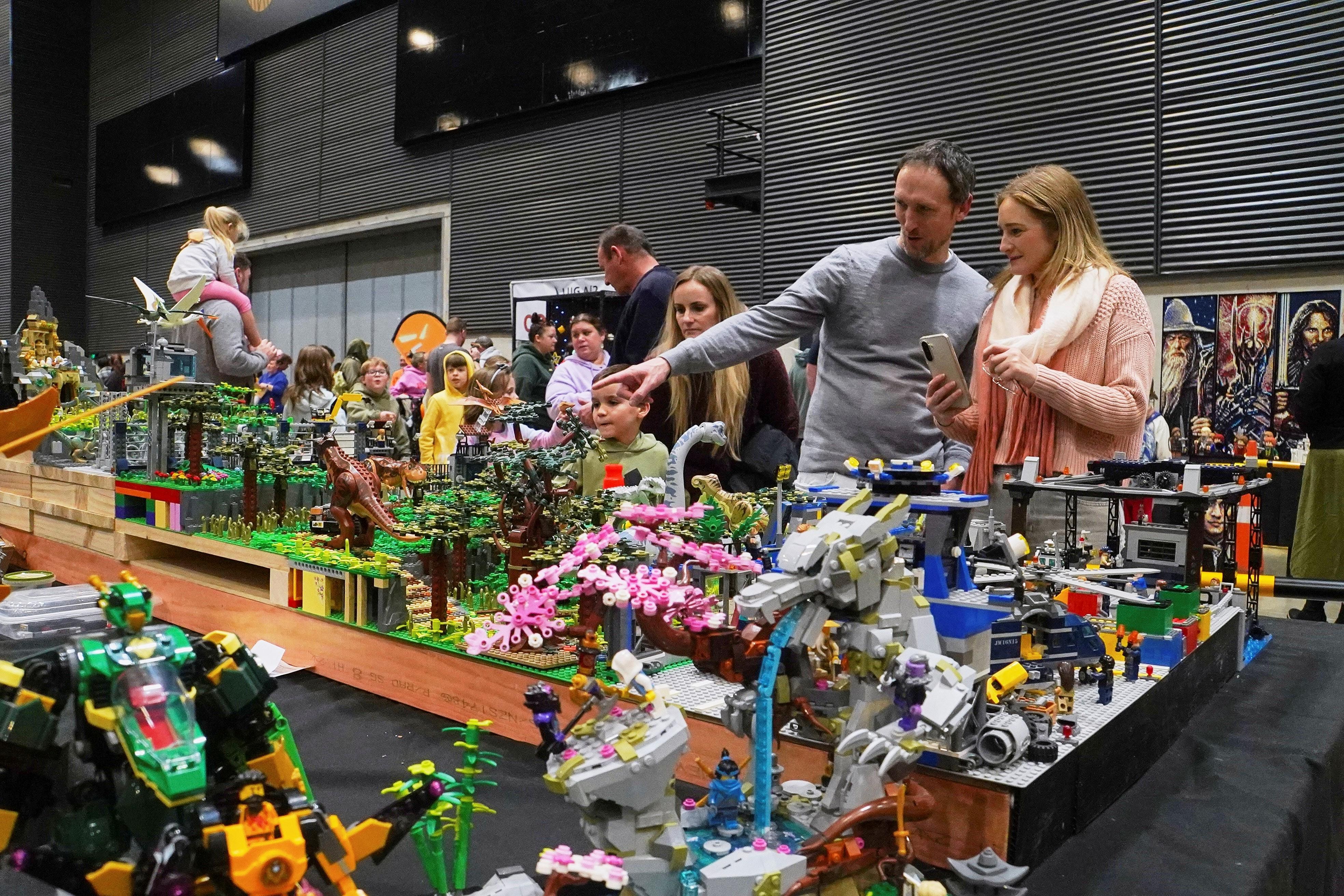
Recently, I was out doing some window shopping with one of my friends. We checked out some of our usual places — a makeup store, a clothing store — but the place where my friend’s eyes really lit up was a toy store. There were floor-to-ceiling displays of Labubus and Funko Pops, Jellycats that looked like croissants, and just about every Hello Kitty product you could imagine.
What really got my attention about the space was not the sheer volume of toys, but the lack of kids. It was mostly people our age, with the same excitement that I saw in my friend. This makes sense when you look at a breakdown of the current toy market: It’s an industry projected to be worth over $130 billion worldwide this year, and as of this summer, American adults with no kids bought more games and toys than households with children. There’s even a name for grownups who aren’t ready to put away the toybox: kidults.
According to Mia Sundstrom, CEO of the National Institute for Play, there’s a reason for our enduring fondness for toys. “The drive to play is actually biologically hardwired into our subcortex,” she told Vox. “Because of that subcortical location, the drive to play actually lasts across the entire lifespan, which means that we’re never too old to play. But our society deeply misunderstands that. We’ve slowly started to take play away as we grow up, and yet that drive is still there.”
So what does play actually do for our brains, and how can we add the playfulness of childhood back into our adult lives? We answer that and more on the latest episode of Explain It to Me, Vox’s weekly call-in podcast.
Below is an excerpt of my conversation with Sundstrom, edited for length and clarity. You can listen to the full episode on Apple Podcasts, Spotify, or wherever you get your podcasts. If you’d like to submit a question, send an email to askvox@vox.com or call 1-800-618-8545.
Adult consumers are making up the lion’s share of the toy industry now. What is happening in our adult brains when we play with toys?
Neuroplasticity means that our brains can adapt across our entire lifespan. Some of the similar benefits that children have with playing with toys, we actually still have as adults.
The primary reason is because of the hand-brain connection, which is essentially a two-way neurological highway. When we do fine motor movement while we’re playing with toys, it stimulates the brain regions that are responsible for our cognitive function, our emotion, and our focus. It activates these deep neural networks that go completely unused when we’re engaging in, say, passive screen time.
When we’re playing with a toy, we’re often doing something we’ve never done before, because play is a space where experimentation and risk-taking and mistakes happen. That is actually stimulating new neural pathways in our brain that support our long-term cognitive health.
The second big one is our amygdala, which is a key part of our emotional processing center in our brain, is relaxed in the state of play. A lot of us live in a stress response right now. Social media doesn’t really take us out of that stress response. It often leaves us feeling more stressed out or drained when we’re done.
I absolutely have experienced that.
But that’s not the case with the toys. When we engage in this play state with toys, our amygdala actually calms down. The amygdala is responsible for our stress response. So our stress, our anxiety, our emotional defensiveness are significantly reduced, and we enter that restorative state, which for a lot of us is really hard to access on the day-to-day.
Toys are a pathway to helping us access that more relaxed emotional state based on the reactivity of our amygdala.
When do we start being told that we’re too old for toys? What do we lose when we accept that?
Sadly, I think we’re being told that we’re too old for toys starting quite early. Specifically, when we hit the teenage years, a lot of play is replaced with, “If this doesn’t have an immediate purpose for my future career, it’s not worth the time.”
That free space to experiment, say, with Lego and even with collections and other things that stimulate our imagination and allow us to enter this world between imagination and reality, starts to slowly dwindle out, almost imperceptibly.
Parents think that they’re doing their children a service by replacing that free play time with structured sports or structured activities. Unfortunately, what happens is, slowly, the intrinsic motivation to do something gets replaced with extrinsic motivation, which very quickly leads to burnout.
It sounds like when we stop playing with toys, that’s when the optimization culture kicks in.
Exactly. We see playing with toys as extra, as a hobby, as something that doesn’t have an immediate purpose toward helping us achieve whatever our goals are. And yet paradoxically, it’s one of the most productive things we can do.
One of the things that I like to ask people is, “Where are you when you get your best ideas?” Now, the shower is the most common answer, but the second most common answer is when they’re playing with toys. You know how no one answers that question? “When I’m at my desk at 10 am answering emails.”
The creative mind flourishes in the space in between, and the space in between is the time that is spent playing with toys. But until people see it like that, it becomes really hard to fit into the hustle culture and the grind of the daily schedule.
How do we relearn how to play?
“Here’s the good news: Even 30 seconds to five minutes a day makes a difference.”
The first step is to think back on our earliest memories of playing, because play is who we were before the world told us who we have to be. The second, which is a derivative of that, is understanding your own play style. For some people, building a Lego set is going to be totally playful. For other people it’s going to be a puzzle or it’s going to be a game night with a board game or a sports league.
And third, this is not about adding more to our plate. Nobody has time for that.
That’s so funny. My first thought is, “I need to put play on my to-do list.”
And that is totally contradictory to the purpose of play!
Here’s the good news: Even 30 seconds to five minutes a day makes a difference. You can put play objects and toys in visible places around your environment so that you reach for that instead of your phone.
If you just crack the door open a little bit with those micro moments of play in your routine, your brain will automatically enjoy it and start looking for more opportunities to play. Just start really small and know that that’s enough.
What do you think the world looks like when adults embrace that playful spirit more?
The world looks more joyful. This isn’t all sunshine and rainbows, and play doesn’t take away from the hard things that it means to be human. Play is a healthy way to express those challenges and to express the full range of emotions.
Play can look mellow and play can look lower-energy, but what it looks like is humans honoring what it means to be human and feeling more connected with your authentic self. When we’re more connected with our authentic self, we’re more easily able to connect with the people around us and establish meaningful relationships. So I see this as a tool for societal flourishing, specifically in a technologically dominated world.
On HALO • 8 hours ago